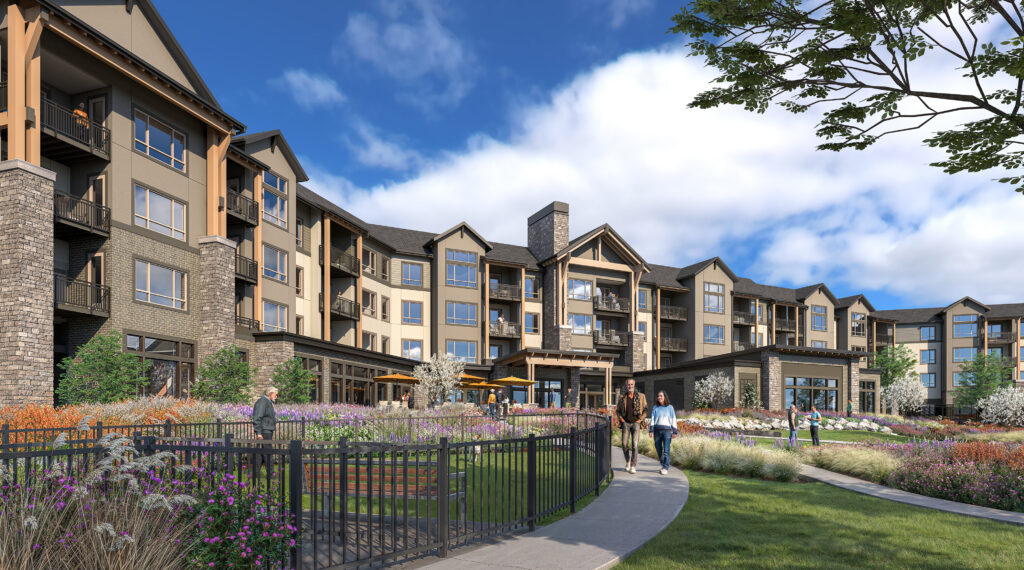
Touchmark Senior Living is expanding to new markets with development projects underway in Alaska and Colorado.
Touchmark’s portfolio was developed and built for the provider, and acquisitions have made up a small portion of the company’s recent growth plans. Alongside newly announced development projects in Fort Collins, Colorado and Anchorage, Alaska, Touchmark’s leaders are undertaking multiple renovation projects within existing communities to prepare for incoming and future senior living demand, according to CEO Marcus Breuer.
The company’s typical development projects have at least 100 units and include pocket-neighborhood concepts that can accommodate features like independent living cottages and villa homes, with each property anchored by a main building with assisted living and memory care offerings.
Touchmark leaders evaluate sites on which to build based on where the company’s target resident base is likely to live, then sizes each community to fit the available property and market. The company’s communities have ranged up to 250 homes, with some even exceeding 400 units, Breuer said.
New development underway, expanding in Colorado, Alaska
The Fort Collins project is slated to transform a 20-acre property into Touchmark on Harmony Ridge in partnership with Brinkmann Construction and LRS Architects. The community is planned to include 193 units of independent living, assisted living and memory care and feature spaces designed for residents to build social connections, engage with fitness programming and take advantage of wellness offerings. Construction is currently underway on the property, which is expected to open in 2028.
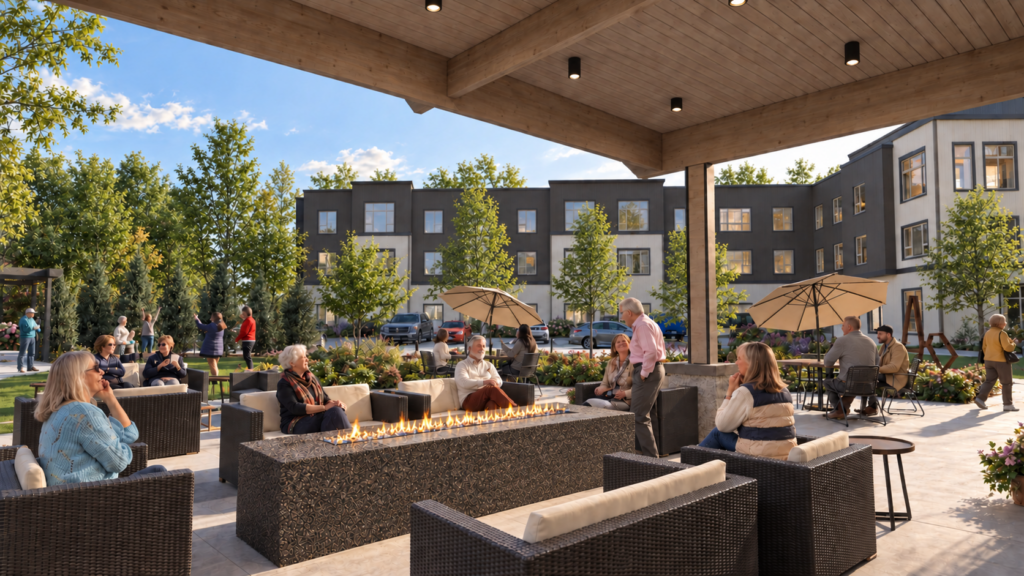
In Alaska, Touchmark is planning to enter Anchorage with a 244-unit, full-continuum community on a 14-acre property. The community will include 120 independent living units, 34 villa homes, 58 assisted living apartments and 32 memory care units. The community will include multiple dining venues, a game room and a theater, alongside a fitness center, yoga studio, indoor and outdoor walking paths, a dog park and a fire pit.
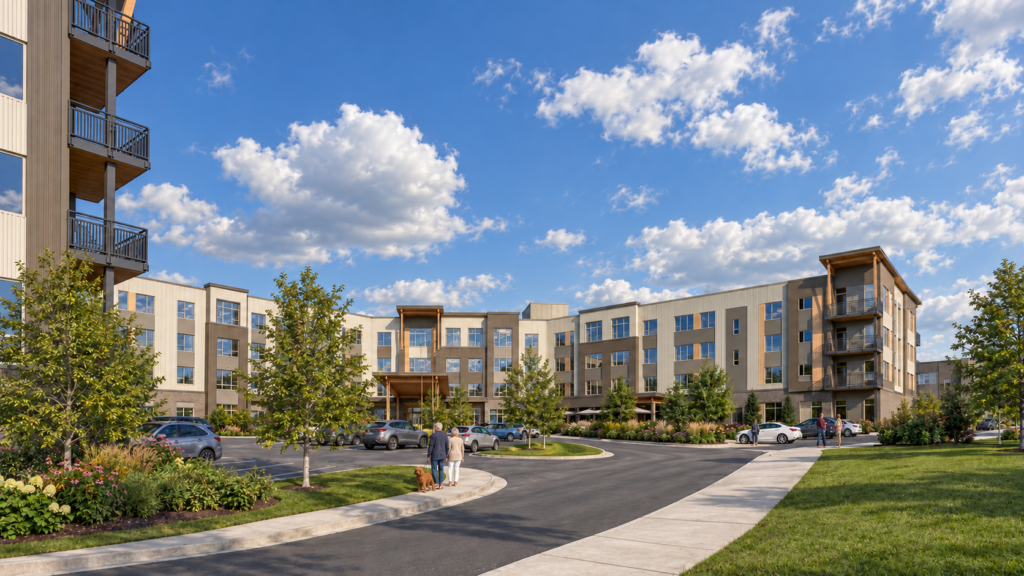 Touchmark Senior Living / Touchmark at Hillside
Alaska is not a typical target for senior living expansion. But despite the logistical challenges of developing in the state, where nearly all building materials must be shipped in via boat, Touchmark is growing in the Last Frontier State due to the untapped demand for senior living. The company’s project is slated to become the first continuing care retirement community in the city of over 287,000 people.
“There is no community there at all that features that whole continuum, and we think we’re going to be a huge asset to the community,” Breuer said. “The city has rallied behind us and provided some great incentives because they see the importance of what we’re aiming to provide.”
While development continues to remain difficult on the whole, Breuer said Touchmark maintains a narrow focus on development projects in markets with strong demand fundamentals, along with limited competition from other providers if possible. Part of the company’s success in new development has come through experience, learning from past design mistakes to prepare projects for the future. For example, the company built a community in Portland, Touchmark in the West Hills, which had a small number of two-bedroom units, and a waiting list quickly formed. In future projects, these types of unit counts typically receive more design and planning space to accommodate appropriate demand, Breuer said.
“This is how we adapt along the way and meet the market wherever we go,” Breuer said.
In regard to future development and the current supply-demand gap the industry faces, Breuer said operators and their capital partners still face an uphill battle when it comes to building new. That’s because financing and construction costs have continued to rise, and senior living development financing hinges heavily on a lender’s confidence that an operator can match its expectations and handle a complex daily operating environment, Breuer said.
“The opportunities are so great if you have a company that can access capital and have the development expertise to deploy it and grow it,” Breuer said. “If you do that, you have the fairway right in front of you.”
Hospitality evolution, campus renovations and operations
The Beaverton, Oregon-based senior living provider currently operates 16 communities in 10 states, including having a presence in Alberta, Canada, serving over 4,500 residents with 3,000 staff. The company focuses on full-continuum senior living communities spanning independent living to memory care, and Touchmark is the owner of all its properties.
Ownership of the properties is something that is important to Touchmark’s leadership to give the communities stability and consistency, while creating a senior living model that relies on resident satisfaction and staff tenure to win over existing and prospective resident support, Breuer said. All Touchmark development projects are funded by the company. This helps eliminate the “natural conflict” that can sometimes take place between ownership groups looking to maximize profits and local community operations maintaining resident and family support.
“We believe decisions about senior care should be guided by residents’ needs, not Wall Street’s return expectations,” Breuer said. “Our long-term ownership lets us maintain the Touchmark standard without properties being continually bought and sold, a stability we believe sets us apart and benefits residents.”
Breuer described Touchmark’s senior living model as taking a hospitality-first approach with an emphasis on improving employee retention through leadership development and training. The company’s latest development projects are directly aimed at appealing to the incoming baby boomer generation and meeting the activity, lifestyle and programming needs that this new cohort seeks, Breuer said.
Future development will happen for Touchmark in phases to allow for design and building practices to catch any elements of a new community that may need to be altered prior to residents moving in, Breuer said. To succeed in daily operations today, Breuer said providers must find a hospitality mindset akin to the Ritz-Carlton or JW Marriott hotel companies to go above and beyond what residents and their families demand today.
“If you think of a JW Marriott or a Ritz-Carlton, a hotel can’t carry that brand unless it meets the brand’s standards,” Breuer said. “It’s the same for Touchmark: our communities can’t carry the Touchmark name unless they meet our standards, which is why we reinvest significantly in our properties.”
Some of those additions include new cafes, pub and bar spaces and restaurant-style seating and service, which serve as social connection hubs for residents to gather throughout the day, Breuer added.
This was felt strongly in some of Touchmark’s communities where dining was still configured in a cafeteria-style format. To update and match how older adults typically eat before moving into senior living, Touchmark renovated multiple dining spaces to meet restaurant-quality standards for both menu and service.
“There’s an evolution that’s happened for us, and we’re updating these communities as hospitality demands have expanded and as people’s preferences have changed,” Breuer said.
In between the company’s bookends of new development projects underway, multiple renovations are happening in Montana, Oregon, Texas and Wisconsin that will add additional units on each campus and upgrade critical elements of communities, ranging from common areas to new dining spaces to modernize the properties. The renovation efforts can be as sweeping as $15 million or $20 million projects that overhaul an aging community’s common areas, dining settings and bring in new amenities for residents, Breuer said.
“We want to attract highly independent, highly ambitious folks who have lots left to give and learn and experience,” Breuer said.
The recent overhaul of the company’s portfolio comes as the company’s assisted living and memory care segments have extensive waiting lists of interested future residents.
The company’s approach to memory care segments the high-acuity sector into multiple levels, with the company’s memory care design focusing on safety and creating a neighborhood feel for residents living with mild cognitive change, and a more traditional memory care segment for more advanced dementia in typical memory care wing formats.
Leadership development is a top priority for Touchmark this year and into the future, and while technology and AI are improving the overall senior living experience, Breuer said the human element and social connection between residents and staff are critical to the company’s operating model.
To build leadership pipelines, Touchmark recruits 10 to 12 staff members to gain experience across departments and communities to prepare them for stepping into future management roles as those jobs become available, Breuer said.
The goal of the program is to have 80% of managers at new communities come from within Touchmark, while ensuring existing communities can backfill positions when new leaders move to new opportunities.
Companies featured in this article:
Brinkmann Construction, LRS Architects, Touchmark Senior Living