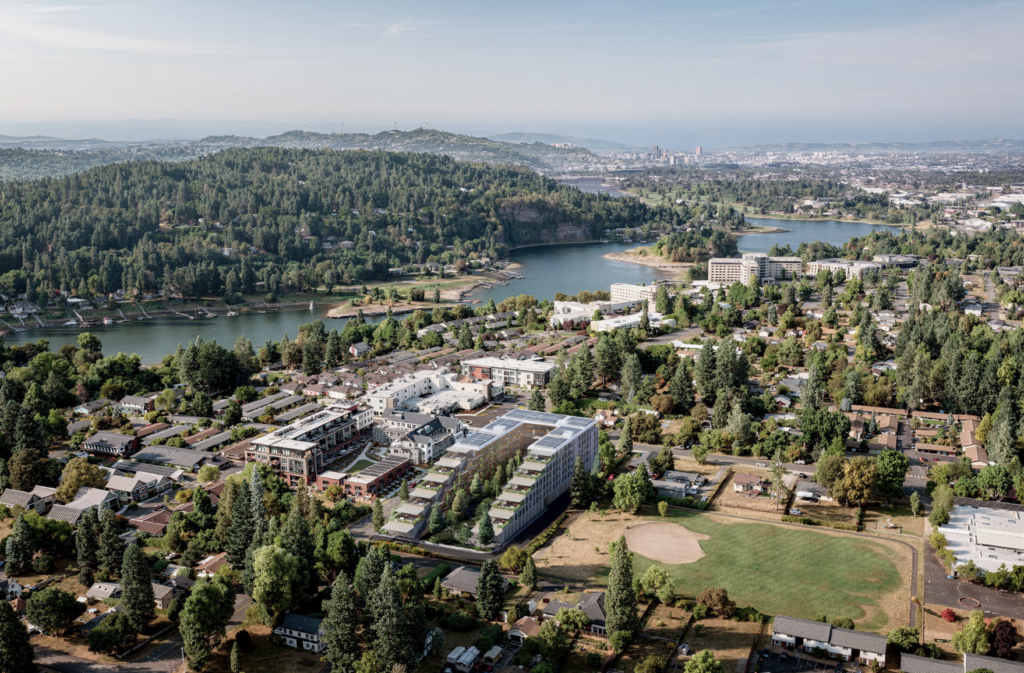
Senior living provider RoseVilla Senior Living is planning three major development projects as part of an effort to advance sustainability goals and create more options for older adults
Among the scope of the work at the non-profit life plan community in Portland, Oregon, is a new facilities and grounds operations center for staff. Following the demolition of an older facilities building on campus, RoseVilla will build a $40 million, 6,000-square-foot wellness center that will also include 12 independent living homes. The community’s leaders are seeking to certify the forthcoming wellness center and apartment homes under the standards of the International Living Future Institute, which would make it one of 37 buildings with the designation internationally and the first senior living community in the U.S.
The new facilities and grounds operations center that will have a rainwater collection system and be built to withstand a category 4 earthquake.
Plans also call for apartments known as Mahonia EcoHomes ranging from 1,300 square feet to 1,800 square feet, and the restoration of a nearby garden to its native oak savanna with a walking trail and wellness amenities. As part of this development, rooftop solar energy is designed to generate 105% of the neighborhood’s energy needs. At present, 11 of the 12 homes are set to be reserved by older adults on the RoseVilla waiting list.
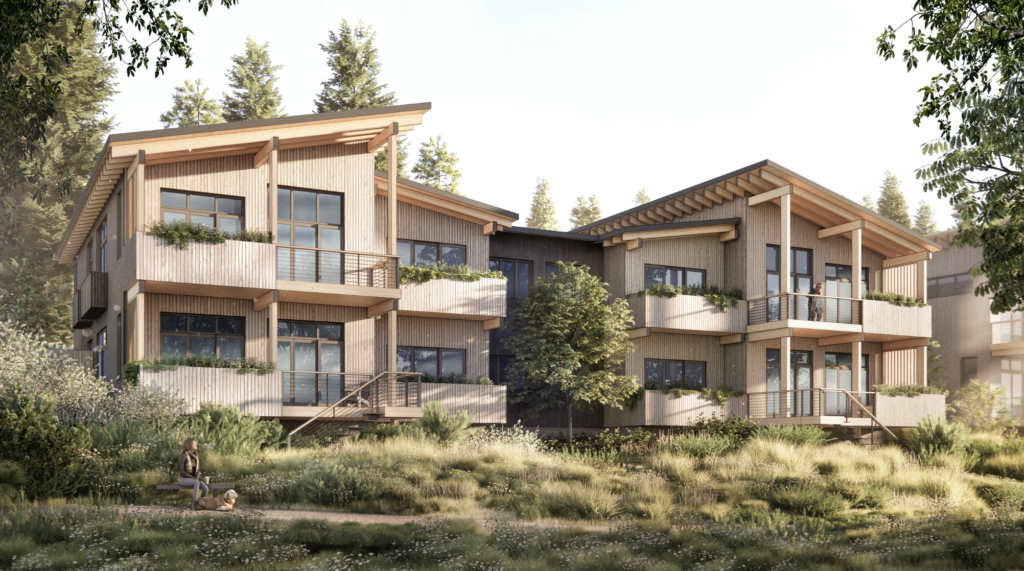 Rendering courtesy of Green Hammer Design + Build/RoseVilla
Alongside this development, RoseVilla is also planning a new independent living and assisted living segment known as the RainWood Lofts that will add 54 IL units and 31 assisted living units to the campus.
Both the Mahonia EcoHomes and the RainWood Lofts are expected to be completed in early 2029. The design and construction of the new developments will be completed by Green Hammer Design Build and Hacker Architects, which previously built the organization’s two existing zero-energy neighborhoods.
The RainWood Lofts is slated to consist of a 200,000-square-foot mass timber building for the independent living and assisted living expansion, the first assisted living offering on the RoseVilla campus.
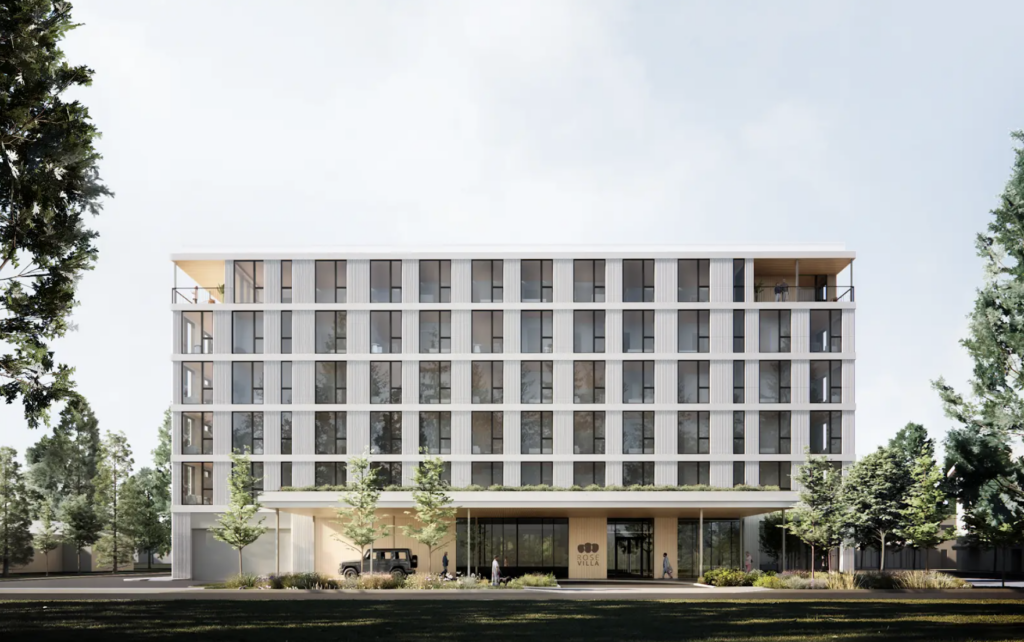 Rendering courtesy of Hacker Architects/RoseVilla
“We’re focused on being the most sustainable senior living organization in the country,” CEO Glen Lewis told Senior Housing News. “These three projects are a major step in that direction.”
RoseVilla previously completed two zero-energy neighborhoods in recent years. After a fire, RoseVilla built a new structure with zero-energy standards in mind along with an electric vehicle charging station.
These new developments stick to RoseVilla’s strategic plan and vision to create the most sustainable senior living campus in the country, Lewis said. As part of the process, the organization formed nine resident-led work groups of roughly 60 older adults who have been “engaged in every piece” of the planning and design of the new elements coming to campus.
On the first floor of the RainWood Lofts, RoseVilla plans to establish a creative arts hub with a wood shop, ceramic studio and glass fusing studio alongside the planned wellness center within the broader 200,000-square-foot, horseshoe-designed building. An art gallery will also be included in the building.
“All of these projects are continuing to live into our sustainability goals and our resiliency goals,” Lewis said.
Lewis views sustainability as RoseVilla’s “north star” in guiding future development and growth at the campus. Throughout the design and development process, Lewis said the decision to build to high sustainability and regenerative standards has helped align with the values of older adults seeking active and purposeful lifestyles.
“By doing so, we enable people to actually live into their values easily and align with us as an organization, and we believe it’s unique for our industry,” Lewis said. “You have to practice what you preach, and we’re putting our money where our mouth is because the customer is more savvy and understands whether we are doing it effectively or not.”
Involving residents in the planning and design stages was important given the organization’s past history of fielding resident feedback and plays to a resident base that is vocal and active in pursuing their values like environmentalism, conservation and sustainability, Lewis said.
“We find the differentiators: that when we enhance the lived experience for future residents, we win. That’s what’s been really important to me,” Lewis added.
Adding assisted living to the campus is in direct response to the rising acuity of older adults entering senior living today. Currently, RoseVilla offers in-home care for older adults in need of increased healthcare services and assistance. While in-home care will remain a staple of RoseVilla’s offerings to residents, Lewis said that adding assisted living will create a greater sense of community for those with increased healthcare needs rather than isolating them within their units.
As baby boomers enter senior living, Lewis said providers must face the reality of senior living evolving to blend hospitality and wellness offerings into supportive living and healthcare services the industry has spent decades perfecting.
“If you aren’t feeling that, then you are not paying attention to what’s happening, and I think that boomers coming to us are really walking in with high levels of expectation and already understanding that lifestyle is indicative of health and well-being, particularly wellness,” Lewis added. “I don’t think we have that fully defined yet as a sector.”
Last year, RoseVilla overhauled its waiting list and used the data from prospects on the list to help guide the organization’s next steps in growth. RoseVilla conducted a range of surveys to understand what incoming prospective older adults want in their senior living experience. The response was “overwhelming,” with common themes in sustainability and wellness offerings from older adults on the waiting list, Lewis noted.
“Wellness is going to be something that we continue to grow at RoseVilla,” Lewis said. “The DNA of it will always remain the same, but [development] is going to evolve a lot.”
As part of this growth effort, RoseVilla will also add additional staff to meet greater demand and accommodate the new amenity spaces by 20% to 25% of its current employee base, Lewis said.
The new living spaces and amenity hubs will be built with wellness in mind, in a “new degree of wellness” through the built environment and aligning with strict sustainability standards. Zooming out, Lewis sees the need for more sustainable development in senior living to meet demand and lessen the sector’s environmental impact in a time when the industry must build at the “fastest pace ever to meet demand.”
“I think about the impact we could have as an industry if we know we need to put that many shovels in the ground and elevate that many buildings,” Lewis said. “Imagine if we did it with sustainability and responsible building in mind.”
This aligns with RoseVilla’s analysis of new and incoming residents who are “actively seeking” a place to live and a community they can join that matches their daily lives and values with an organization focused on creating a lasting, positive legacy, Lewis added.
Companies featured in this article:
Green Hammer Design Build, Hacker Architects, RoseVilla Senior Living